Apogee
A two-stage rocket ascent simulator with shooting-method optimization for circular Low Earth Orbit (LEO) insertion.
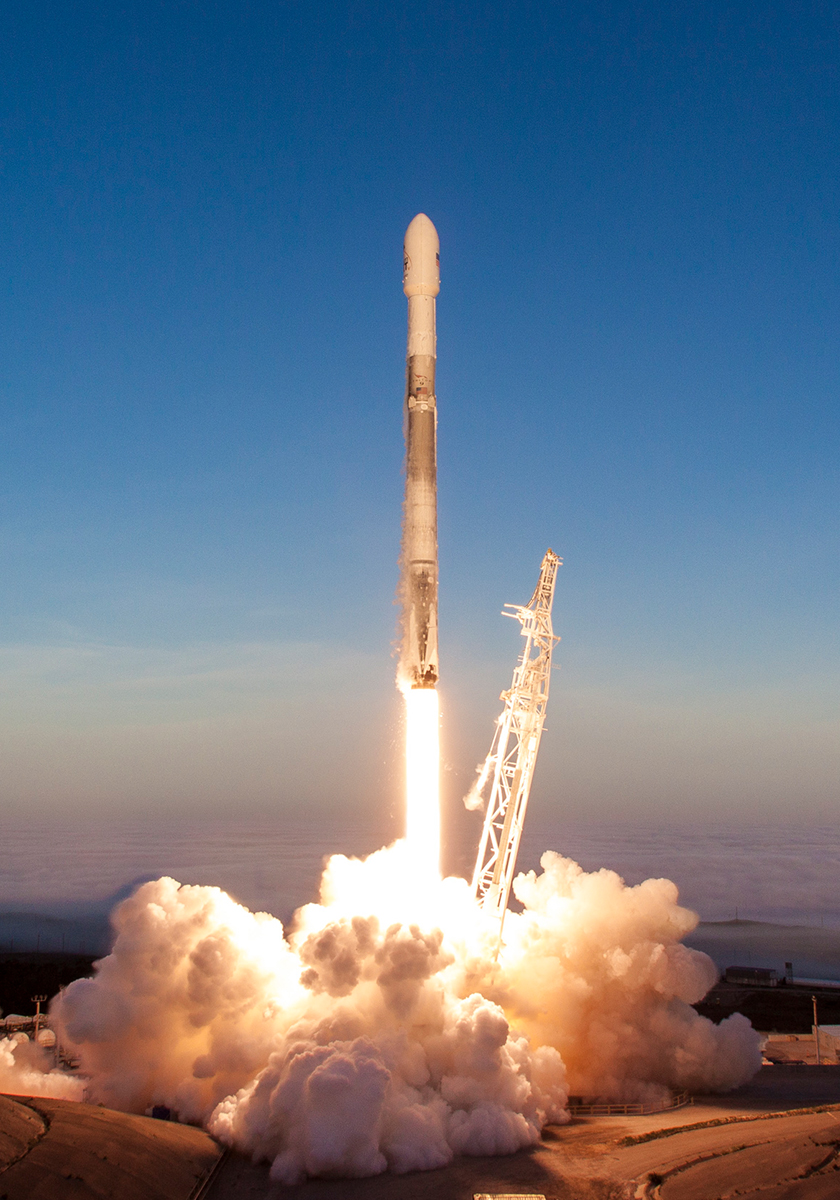
Overview
Apogee is a comprehensive space mission simulator designed to model the complete lifecycle of a satellite deployment mission. It combines rigorous mathematical modeling with modern numerical methods to achieve highly accurate circular orbit insertions.
Key Capabilities
- Target altitudes: 160–400 km LEO
- Payload capacity: 0–10,000 kg
- Orbital accuracy: Eccentricity < 0.001
- Velocity error: < 2 m/s
Mission Phases
| Phase | Status | Description |
|---|---|---|
| 1. Rocket Launch & Ascent | ✅ Complete | Two-stage Falcon 9 simulation with gravity turn |
| 2. Orbital Insertion | ✅ Complete | Shooting method optimization for circular orbits |
| 3. Orbital Propagation | ✅ Complete | Yaw steering for solar panel optimization |
| 4. 3D Visualization | 🚧 In Progress | Real-time trajectory rendering |
Mathematical Foundation
The simulator is built on first-principles physics:
Where:
- \(r(t)\): Geocentric radius [m]
- \(\lambda(t)\): Downrange central angle [rad]
- \(v(t)\): Speed magnitude [m/s]
- \(\gamma(t)\): Flight-path angle [rad]
- \(m(t)\): Vehicle mass [kg]
See Theory → State Vector for complete derivation.
Design Principles
The implementation follows these core principles:
- Mathematically rigorous: Every equation explicitly derived and mapped to code
- Numerically robust: Adaptive RK integration, event root-finding, bounded optimization
- Physically accurate: USSA76 atmosphere, variable mass dynamics, non-constant gravity
- Production-ready: JSON-serializable output, FastAPI backend, modular architecture
Quick Start
# Install
git clone https://github.com/daxrpm/apogee.git
cd apogee && uv sync

# Run simulation
uv run apogee-launch --h-target-km 200 --payload-kg 5000
from apogee_launch import solve_to_circular_orbit
result = solve_to_circular_orbit(
h_target_km=200,
payload_kg=5000,
)
print(f"Eccentricity: {result.summary['ecc']:.6f}")
print(f"Altitude error: {result.summary['h_err_m']:.1f} m")# Start server
uv run uvicorn apogee_api.main:app --reload
# Simulate launch
curl -X POST "http://localhost:8000/launch/simulate" \
-H "Content-Type: application/json" \
-d '{"h_target_km": 200, "payload_kg": 5000}'Package Architecture
apogee/
├── packages/
│   ├── apogee-physics/     # Core numerical engine (JAX/Diffrax)
│   ├── apogee-launch/      # Launch simulator + CLI
│   ├── apogee-orbit/       # Orbital mechanics & yaw steering
│   └── apogee-api/         # FastAPI REST backend
└── frontend/               # React Three Fiber 3D visualization
Documentation Sections
-
:material-book-open-variant:{ .lg .middle } Theory
Mathematical derivations for rocket dynamics, orbital mechanics, and atmospheric models.
-
:material-function:{ .lg .middle } Numerical Methods
Step-by-step explanations of ODE integration, shooting method, and optimization algorithms.
-
:material-package-variant:{ .lg .middle } Package Reference
API documentation for all Python packages with code-to-equation mapping.
-
:material-rocket-launch:{ .lg .middle } Getting Started
Installation guide and your first launch simulation in 5 minutes.
Academic References
This documentation includes proper citations to foundational texts:
- Battin, R.H. (1999). An Introduction to the Mathematics and Methods of Astrodynamics
- Curtis, H.D. (2013). Orbital Mechanics for Engineering Students
- Stoer & Bulirsch (2002). Introduction to Numerical Analysis
See Reference → Bibliography for complete citations.